LSSM World
LSSM WORLDIDEAS FOR THE WORLD WE BUILD

More room
to be human.

Technology should give people more room for care, curiosity, ownership and contribution. The question is how to build systems that make that ambition real.

Read the manifesto ↗Explore the model ↗
Enter the journal
AN OPEN JOURNAL

Choose your way
into the argument.

Begin with a question you care about.
Follow the ideas, examine an example and make a reading path of your own.

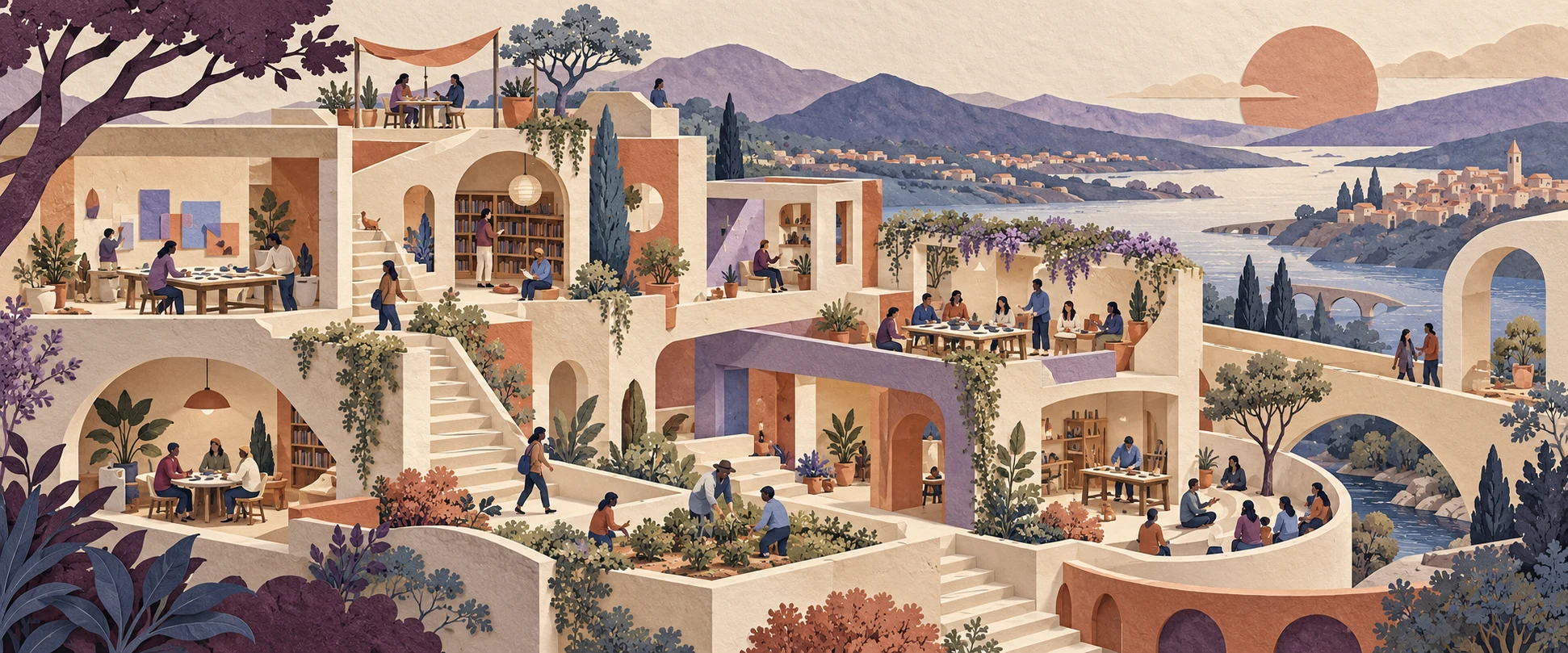
Editorial illustration of connected terraces and open rooms where people learn, create and spend time together.
AN ILLUSTRATED POSSIBILITY

Places are made of relationships.

CHAPTER 01READ AT YOUR OWN PACE

The relationships make the system

Goals, people, institutions and technology shape each other. Start with the larger picture.

Read this chapter
Try a thought experiment

Imagine a shared home trying to coordinate everyday work. A better notification may help, but it does not decide who takes responsibility, how people agree or when someone can say no.

Where would you begin?

Start with who is affected, what they need and which choices belong to them.

An illustrative question to explore, with more than one useful answer.

A STARTING THOUGHT

A useful system can succeed by asking less of us.

It can remove repeated explanation. Make a decision easier to understand. Let people coordinate without turning every handoff into another task. Its value is not the attention it captures, but the possibilities it creates outside the interface.

Continue reading ↗
Put the principle in an everyday situation.Compare the choices · 3 ways to look closer

A tool can be powerful and still ask too much of the person using it. Examine what a useful change would look like.

What is the person struggling with?
A CONCRETE SITUATION

Make a beginning visible.

A person can ask for almost anything, but does not know what to do first.

A SMALL DESIGN EXPERIMENT
Possible change
Make room for tomorrow.

A recognizable task gives the possibility somewhere to begin.

  • Choose what matters
  • Make a small plan
  • Adjust it to your day

A clear beginning can coexist with room to explore.

Illustrative interfaces. Compare the starting point with a possible change.

Read the design question
What changes

A clear task, example or guided next step makes the available capability easier to approach.

What stays explicit

Exploration and personal choice should remain available beyond the default.

FOLLOW THE CONSEQUENCE

Judge whether the person can begin useful work with less repeated explanation, rather than treating more time in the interface as the goal.

Where this explanation comes from

An exploration of LSSM World’s stated principles. These are design questions and hypothetical situations, not measured product results.

CONTENTSFOUR WAYS INTO THE ARGUMENT
01

The relationships make the system

Goals, people, institutions and technology shape each other. Start with the larger picture.

Read a little furtherAn opening passage · the reading path

Look beyond the individual tool

An organization does not improve simply because one component becomes more capable. Outcomes also depend on who can decide, how people coordinate, what information they can use and how they learn from results. The model asks us to make those relationships explicit, so a technical change can be understood in the social system it enters.

Explore the argument
02

A language model is one component

Place generation inside purposeful work, decisions and consequences.

Read a little furtherAn opening passage · the reading path

Use generation where it is useful

A model can draft a proposal, explain a complex record or help translate a goal into implementation work. Those contributions can be valuable without making the model responsible for the entire system. The surrounding workflow still needs a way to establish the relevant context, test an output and decide what action is appropriate.

Explore the argument
03

Attention and choice

The values that should guide the work—and the questions they create.

Read a little furtherAn opening passage · the reading path

Make usefulness larger than engagement

A good tool can succeed by needing less of your attention. It can remove repeated explanation, make a decision easier to understand or let a team finish work with fewer interruptions. Time spent inside the software is not enough to tell us whether any of that happened. The value lies in the possibilities it creates outside the interface.

Explore the argument
A NOTE ON EVIDENCE

Keep the claim and its support together.

An argument becomes more useful when you can see what supports it, what it does not establish and where uncertainty remains.

Thesis

A proposed explanation or direction. Make its reasoning and assumptions available to the reader.

Implementation

Source and a reproducible example can show how a principle becomes software, within a stated scope.

Observation

A result from use needs its conditions, method and limits. An unexplained score is not a substitute.

How much does this piece of support establish?Examine the support · 3 ways to look closer

Consider the claim: “This workflow reduces repeated work in a weekly update.” Different evidence answers different parts of that claim.

What do you have in hand?
A CLAIM TO EXAMINE

You have a direction to examine.

The intended benefit is described for a recognizable person and recurring task.

MATCH THE CONCLUSION TO ITS SUPPORTYou have: A direction
  1. 01A directionWhat might help
  2. 02An artifactWhat was implemented
  3. 03An observationWhat happened in context
THE QUESTION IT CAN ADDRESS
Could this reduce repeated work in a weekly update?

Make the proposed workflow inspectable.

KEEP WITH THIS SUPPORT
  • The person and recurring task
  • What should become easier
  • What would count against the idea

An illustrative evidence map, with no measured time-saving result claimed.

Inspect the claim’s limits
What it supports

The claim can guide what to build and what to observe.

What it leaves open

It does not show that an implementation exists or that the benefit occurred.

WHAT WOULD HELP YOU DECIDE

Name the repeated work and the conditions that would make the improvement recognizable. Ask what would weaken the claim.

Where this explanation comes from

A hypothetical claim used to distinguish thesis, implementation and observation. No time-saving result or completed measurement is claimed.

FROM IDEAS TO WORK

Follow the ideas into practice.

The ventures turn these ideas into concrete work for different people. ContractSpec powers their specifications and capabilities, LSSM OS provides infrastructure, and BrainOS connects useful context. Explore the products and their source evidence, then follow the relationships that matter to your question.

Follow the relationship, not only the tool.Trace the mechanism · 3 ways to look closer

Imagine a person learning a skill, a team doing useful work and a community creating opportunities. A local improvement depends on the connections around it.

Which relationship are you examining?
A CONCRETE SITUATION

Capability needs a useful place to go.

A person learns something new but cannot see how it connects to a next step.

01 / Capability

What can the person now do or understand?

What changes

Relevant context and understandable opportunities can make the learning actionable.

What stays explicit

More information alone does not guarantee access, readiness or a good fit.

FOLLOW THE CONSEQUENCE

Ask whose goal is served, which next choice becomes easier and what conditions still block it.

Where this explanation comes from

Hypothetical relationships from the World model and company purpose. These questions explore a thesis rather than asserting an observed social outcome.

Your view

Make room for your context.

Shape the presentation around this moment. You can change it whenever you need.

Your context

The different parts of you

Choose a starting point

A useful mix of context, visuals and gentle guidance.

Tune each dimension
Each dimension can change independently. Product permissions and available actions stay unchanged.

Support the way you begin and return

Tune your support

Reading comfort

Choose your language

Interface language changes text only. Markets, prices and workflows keep their own settings.

Translation coverage

Original source

Navigation151
Graph616
Categories378
Portfolio833
Examples2,035
Source preview1,542

More translations will be added as content is reviewed.

This preference is saved on this browser.

Search the website

Useful starting points

No results. Try a shorter phrase, an operation name or another search area.

A LITTLE ROOM TO EXPLORE

Find something to explore.

Open a closer look on this page, try a different perspective, or follow the detail into its own page.

How previews and controls work
01

Look before you leave

Hover a link or focus it with Tab to see a preview. Clicking the original link or pressing Enter always opens its destination.

02

Stay with the context

Move into the preview to explore its sections. Use Alt + ↓ from a focused link to enter it with the keyboard. Escape closes it.

03

Open the possibilities

Disclosure rows, perspective choices and highlighted controls reveal more. Your view changes reading comfort and the context you explore.

A separate button for a closer look

Show small preview buttons beside links where there is room. Tap the eye to inspect, or tap the link to go straight there. This choice stays in this tab.

No browsing history is collected. Reduced motion follows your device and Your view.